SINGAPORE: INTO THE FUTURE


COPING WITH LAND SHORTAGE, HOUSING NEEDS & POPULATION CONGESTION

A friend, who had read my article entitled My Crystal Ball Visions on Malaysia-Singapore & Myanmar (posted on Aug.7, 2013) asked me a couple of mind-prodding questions while we were having a chit-chat session. “What do you foresee regarding how Singapore will cope with the shortage of land issue two or three decades from now? And how many Singaporeans really want to set up homes in their neighbouring Malaysian soil instead of merely buying properties in the Iskandar Development Area (which is adjacent to the island nation and just a “stone’s throw” away) for investment only?”

I was quick to retort: “I do not have privy information on affirmed plans of Singapore’s future landscape, so it is not apt for me to predict without concrete basis. But let me ask you this question for ponder, what options does the small island nation have now to overcome the issue 20 or 30 years down the road?” He appeared perplexed.

I elaborated to him that land space availability to cater for a significant population growth will be a concern Singapore has to face up. According to a report by AP in February this year, the projected population by year 2030 would reach 6.9 million – an increase of 1.3 million from present. Naturally, the Singapore Government can be expected to have already proactively drawn out plans as pre-emptive options.

Perhaps, one of the ready options open to the Government is to continue land reclamation in order to extend the coastline further. After all, sea reclaimed land already accounted for one-fifth of the island’s total land area to-date.
 (One of the reclamation projects to increase land space, which will change the shape of S'pore)
 
Although Singapore may claim sovereign rights over some distance of territorial sea span, yet such a move is not without challenges. First, continuous ample sand supplies must be available. My research via Google revealed Malaysia and Indonesia stopped supplying sand since 1997 and 2007 respectively. Cambodia has somewhat restricted sand exports. Invariably, scarcity in supply will lead to marked increase in prices on demand.

Secondly, there is also the moral element relating to marine environment conservation to contend with. Few years ago, Malaysia expressed concern of harm to marine environment which could negatively impact the livelihood of small fishermen living at the coastline of its Johor State due to Singapore’s reclamation activities along the Straits of Johor, the channel between Johor  and Singapore. Malaysia also argued that reclamation at the Pulau Tekong point of Singapore would bring about navigational difficulty due to narrowing of the channel. The matter was resolved when the International Tribunal of the Law of the Sea mediated for minor changes to moderate the reclamation works at Pulau Tekong and for monitoring of ecology. International environmentalists are against large scale dredging of river and sea sand as they fear such activities, if unabated, can lead to depletion of fish stock, altering tidal flows and water levels, and also be detrimental to long distance migratory birds which rely on intertidal mudflats for sustenance.

Perhaps, another (alternative) option is to explore the possibility of subterranean or underground living as the future frontier. According to AP, the Building Construction Authority said such scene could materialise by 2050. I am not surprised about this talk. As it is, below-the-surface development has taken place. A blog in the name of My Property Guru wrote about Phase 1 works on the Jurong Rock Caverns project at the depth of 130 m., to cater for storage facilities. Already, underground stations and retail shops exist.  It is just a matter of expanding and extending more sideways and downwards for other purposes. CNN Travel, in an article three years ago, reported the Economic Strategies Committee (ESC) was formulating the Underground Master Plan.
(Part of the Rock Caverns development works earmarked for storage facilities)

The concept of subterranean living is not new. Yahoo News carried a report that Holland had planned to build an underground sub-city in (or more aptly phrased as “beneath”) Amsterdam at the estimated cost of US$14.4 billion, commencing 2018. The structures would be beneath the canals and streets of Amsterdam.
(Model subterranean homes overseas - will these examples be part of the living scene in S'pore?)

But would living underground be conducive for people? Would it be devoid of natural light and fresh air? Would there be water seepage problems? What about the acoustic effect? What about any health impact risks? These may be the probable issues to overcome for the option to be practical.

Perhaps, having more Singaporeans relocate to set homes in Iskandar Development Area in Johor State, Malaysia may be a viable option. Bearing in mind that the development of Iskandar area itself and major new property schemes are on joint ventures between parties of both nations, surely the Singapore Government would encourage Singaporeans to support the projects. Success of the JVs will contribute to the GDP and GNI growth of Singapore.
(Map of Iskandar Development Area - perimeter marked in red. Adjacent to it is Singapore - shaded in white. In between is the channel, Straits of Johor)

I foresee two categories of Singaporeans as potential home setters in Iskandar:

·        * Those working for the JV projects. Shuttling daily between the two territories is less practical than staying around where they work. Convenience of proximity is the key consideration.

·        * Those preferring to live in more luxurious residential properties available at affordable costs – i.e. leveraging on “earn in Sing Dollars and buy in Ringgit” purchasing power. An average 4-room HDB (Housing Development Board) flat costs around S$500,000. With that sum converted to RM at the current rate of 2.6 times, it is more than sufficient to buy an up-class landed spacious house in Iskandar. Or they can go for a posh condominium with good facilities.

(1. A two-storey terrace house at very affordable price of RM390,000.  2, A spacious and posh property priced at RM1.26 million. How much will these types of properties cost in Singapore, in Sing Dollars???)

Certain doubts may linger in some Singapore nationals whose socio-cultural values, behavioural and general mind sets are different than Malaysians. The key deciding factor is, how many Singaporeans would feel comfortable settling down in the Malaysian environment? For example, I have heard often times from some of my contacts in the island expressing surprise over the frequent untoward events, including crime episodes, prevailing in Malaysia. But I also have quite a few friends from the island who love to visit Malaysia now and then for food flair and landscape variety.

The Star (Malaysia) newspaper carried an interesting story on August 20. It quoted a Johor state assemblyman claiming that more than 200,000 cars from Singapore entered Johor Baru city, which is within the perimeters of Iskandar, daily via the main Causeway and Second Link Crossing. The report did not specify how many of the commuters were Singaporeans; neither did it mention whether the figure included Malaysian registered vehicles returning home from the island. Nevertheless, the news proves a point – many islanders do not shy away from their immediate neighbourhood. Another news report – by Straits Times (Singapore) –  recently highlighted that Singaporeans made up 74% of the non-Malaysian buyers of properties in Iskandar developed by UEM Sunrise. Most of them were said to those frequently going to Johor for business and those seeking a weekend home. Who knows, they may ultimately settle down in Iskandar permanently.

Perhaps, the best option is the combination of the three likely options. Intense congestion is naturally expected in the next few decades. Open land space availability can be predicted to be a more serious issue than now, not just catering for homes but more so for industrial and commercial requirements. Thus, the executive power of Singapore must optimise whatever avenues it could grasp in order to thrust the island nation to a vibrant future, like what it has done over the past few decades.

IMPORTANT NOTE: The contents of this write-up are reflections of my personal perceptions, and not referring to affirmed official views or information cited by any relevant authorities of Singapore.  Readers are invited to share their thoughts, whether in consonance or dissonance with what I personally foresee.

Discovery Of Outlet Serving Relishing Dishes


HUMBLE FOOD OUTLET IN IPOH WHICH CONCOCTS RELISHING DISHES

Calling all Malaysian gourmands of Chinese food………I want to declare that I recently discovered a down-to-earth food outlet in Ipoh which concocted seemingly simple dishes but greatly satisfying my taste buds. 

On Aug. 2, I drove from Kuala Lumpur (KL) to Ipoh, which is known for its “brand name” culinary varieties, or shall I call them delicacies. I thought it was a good idea to visit the city – where I was born, bred and even worked in my earlier career ears – once again, just for a “makan-makan” (feasting) spree.

I was introduced to this outlet, which I had never patronised before, by close buddy Dr. Michael Chong in the evening of my second day stay. He assured me beforehand that I would relish the dishes although not served in a posh environment. (Thanks to Michael for his hospitality)

Choon Keng Seafood Restaurant, sited among other stalls in Ocean food centre at Jalan Lim Bo Seng, is operated by a former chef of a renowned Chinese restaurant chain who wanted to venture into his own signature dishes. 

We had five dishes. including a dessert. Unlike the cuisines of posh restaurants, the servings looked ordinary and non-exquisite. “The difference is in the taste, not in the presentation style,” said Michael. Sure enough, each dish exuded a lingering sensation rapturing my taste buds.

Instead of wordy narratives, I prefer to let my snapshots and the captions describe the dishes below:
 (Ingredients: Baby squids, fish slices, shrimps, long beans, spicy assam gravy. Cooked inside a tin foil so that the aroma was contained in the contents.We had to cut open the tin foil to savour the dish. The aroma lingered in my palate for quite a while. Good blend of sour and sweet spicy gravy)             
(Vegetable stew Cantonese style. It was a balance between gravy and soup. Raw eggs and cut pieces of century eggs spiked up the slightly starchy texture of the gravy-soup)
(Fresh  fish head meat braised with ginger strips and a tinge of rice wine in a clay pot. The soupy gravy was very tasty. It gave me a feeling of warmth in my body within 5 minutes)
(Large size toufu or beancurd with fried minced pork and spring onion gravy. Simple but splendid)
(Chinese pancake is a common dessert in Chinese restaurants. However, the difference of this one in the picture was how it was fried. Thin, crusty and very crispy skin on the surface covering a full body of lotus paste inside. The rich taste spread and lingered in my palate at each bite)
  
Food was great but what about the cost?  Allow me to equate the relativity in terms of average pricings charged by similar type of food outlets in the KL area. In my estimate, such dishes for four customers served at a food centre in KL and its vicinities like Petaling Jaya may levy approximately RM160 to RM180, or even RM200. The bill from Choon Keng (excluding drinks) was much lower by far margin (I do not think it is fair to quote the exact bill without the prior consent of the operator and my host). Yes, you can guess it was below RM100……..how much below, I will not say.

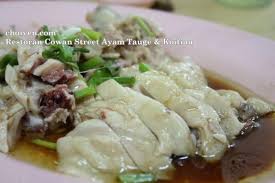
If you are a gourmand residing around KL or Penang, you may want to venture out by taking a two-hour leisurely drive to Ipoh (Ipoh is in between KL and Penang) just to try out this outlet. After all, Ipoh has many “brand name” foodstuffs for you to explore at the same time, like the popular juicy taugey (bean sprout), succulent chicken meat, crunchy chicken "spare parts" (internal organs), soft chicken feet and smooth sar hor fun served by Restoran Cowan Street, which is one of my favourite spots too. See pictures below:
Braised Chicken Feet
Ipoh Sar Hor Fun(Pictures extracted from websites. Top to bottom: Juicy fresh bean sprouts, succulent chicken meat, crunchy chicken "spare parts", soft chicken feet and smooth sar hor fun)

Note: I also like to extend my thanks to another buddy Tan Choon Kiang for hosting dinner at Restoran Cowan Street in the first evening of my visit.


MY CRYSTAL BALL VISIONS ON MALAYSIA-SINGAPORE & MYANMAR


My new crystal ball has recently showed me interesting visions of Malaysia-Singapore (as one common territory) and Myanmar in the not-so-far future of within 10 years or slightly more. But first, it cast an overview of some events that are taking place in the two territories, and indicated to me that these will trigger the realisation of the future visions.

MALAYSIA-SINGAPORE

Current Scenes:

1.      . Various prominent joint ventures have been or are being sealed between Singaporean corporations with Malaysian counterparts to transform the flagship Iskandar Development Area of Johor, the southern state of Malaysia likened as “across the street” neighbour of island nation Singapore (separated by the narrow Straits of Johor for less than 2 km). Mega deals on properties, amenities and infrastructures are lined up for implementation roll. Singaporean developers have begun to build up land holdings in Iskandar. Also, Singaporean contractors are set to be involved in the JV projects.
(Modern homes will mushroom in Iskandar - JV projects of established developers)
(Legoland attracts families, especially children, from Singapore during weekends)

2.       . The new Customs & Immigration Complex and the new ferry terminal at Puteri Harbour in Nusaja, which is part of Iskandar, just opened about three months ago, UEM Land, the operator of the terminal, has started catering trips to Batam Island and Tanjung Balai Kariman in Indonesia. Plans are afoot to extend services to Singapore in the near future. Pueteri Harbour is also being modelled as a waterfront integrated marina theme park.

3.      .  An agreement to connect the Mass Rail Transit (MRT) between Singapore and Johor Baru (JB), the capital city of Johor, has been cued. Target date for completion is 2018.

4.      .  Also, a high speed train service is in the pipeline for launch in 2020. The service will cut down travel time drastically between Kuala Lumpur, the capital city of Malaysia, and Singapore City to 90 minutes from the present 6 hours by normal express train.

Future Visions: 

1.      .  Increased daily criss-cross commutations of Malaysians and Singaporeans in view of public transportation ease.

2.      .  More Malaysians working in Singapore but residing in Johor Baru and the Iskandar area. I also see visions of many Singapore-based foreigners setting homes in JB but continue to work in Singapore in view of the stronger Singapore Dollar and attractive remuneration offers.

3.      .  More Singaporeans owning second or weekend homes in Iskandar where impressive residential properties supported by up-to-date amenities will be up for grabs. Staying in JB or Nusajaya and working in Singapore will be a good option for those who prefer larger living space at lower cost.

4.       . New residential colonies in Iskandar will portray a cross-national identity with mix of Malaysians, Singaporeans and some other nationals. I see the vision of at least 50 per cent of the living population in Iskandar being foreigners.

5.       . Whilst the prices of residential properties in the small island nation are now much higher than its immediate neighbour even without converting the Singapore Dollar to Malaysian Ringgit, home costs in JB and Iskandar will escalate to significant levels due to intense demand.

6.      .  Both nations will benefit economically from JVs. In particular, Iskandar will be the main beneficiary. Job growth will head for a steep trajectory in the next 5 years. From the island, qualified technocrats will be in demand, especially for JV projects. Sectors related to property development, education, healthcare and tourism will flourish in accordance to master plans already paved for roll-out.

And what does my crystal ball show me about Malaysia being able to catch up with Singapore in terms of economic status? Would Malaysia attain its ambition of becoming a developed and high income nation by 2020? Definitely, Malaysians will be much better off than now due to the fray of development initiatives under the New Economic Model (NEM), Economic Transformation Programme (ETP) and Government Transformation Programme (GTP). However, my crystal ball projects a hazy picture of the dream economic ambition. It transmits the message that developed nation status is attainable but the present progress toward this end reflects a challenge. Malaysia must hit more than 6 per cent annual GDP growth on the average from now till 2020. One thing certain is the “advance developing nation” in event the dream target could not be reached. And what about the high income label? Well…….it is highly possible if based on the latest criterion set by World Bank at US$15,000 Gross National Income (GNI) per capita. As at end of last year, Malaysia scored US$9970 GNI per capita, so this target is not too far away to achieve by 2020…….provided the criterion does not change along the way. What is more definite is at least the high middle-income status in event a shortfall occurs due to any upgrade in criterion.

MYANMAR

Current Scenes:

1.      .  The country is expected to open up to more democratic reform in the next three years or so. At the same time, foreign investments have begun to flow in, especially by corporations keen to be pioneers in penetrating the foreseeable expanding markets.

2.      .  Urbanization is increasing at rapid speed. Most Myanmar nationals now live in the countryside or outskirts of urban areas.

3.      .  Development is set to spread at speedy pace over the next few years.

FUTURE VISIONS:

1.      .  From just over  10 per cent of the population now residing in large cities,  the ratio will be more than triple in less than 20 years. 

2.       . Vibrancy of the lifestyle industry at large, such as hotels, restaurants, bars, entertainment, recreation outlets etc. Bars and pubs in particular will be more prolific. A big market for beer is envisaged. Carlsberg must have identified the vast business potentials and therefore venturing into a partnership with Myanmar Golden Star Breweries to move into the local market. Perhaps those are the same reasons for Heineken to embark a tie-up with Alliance Brewery Company (ABC). Skol will be available in the market too.
(Above:Lively and posh pub in Yangon. Below: A punk rock band performing in Yangon)


3.      .  Tourism will flourish. I see Myanmar as another popular holiday destination in the region and a competitor to Thailand, Indonesia and Vietnam.  In this respect, many new hotels will crop up to facilitate holidaymaking, business meetings and conventions.
(Three popular tourist spots among the many attractions that Myanmar offers to visitors)

I am Malaysian. I foresee substantial Malaysian entrepreneurs and corporations scouting opportunities to establish  business there. Malaysian Airlines System (MAS) already has increased the number of flights to Yangon, the capital of that country. Australian owned Jetstar is also increasing flights between KL and Yangon. I see other airlines following suit. I am sure the airlines industry expects a swell in passenger demand in the next 5 years. Tan Chong Motors, the main dealer for Nissan cars in Malaysia, is venturing with exclusive rights to sell its brand of completely built-up (CBU) vehicles in Myanmar, aimed for longer term returns than immediate.
(Tan Chong Motor's Nissan cars ready to penetrate the car market in Myanmar)

(Note: All pictures in this article are extracts from various websites)

(Special note: The contents of this sharing are my personal opinions extrapolated from prevailing events and personal research. My views may or may not be consonant with the perceptions of other analysts and readers on the subjects. I welcome comments from readers)

Powered by Blogger.