ATTRIBUTES OF AN ASTUTE MENTOR CUM COACH


FOREWORD: This postulation is the sequel to my previous two articles on "How To Become A Protagonist", and "Vitality Of Leading Plus Tactical Coaching". Indeed, the subject of mentoring coupled with coaching is intense when it comes to application. Such efforts require dedicated focus by an aspirant.

Three essentials must be at hand before an aspirant pursues to be a mentor cum coach - the acronyms of the 3C's: * CARE; * CONCERN; * COMPASSION.

* CARE ...... Care for the well-being of group members under his purview. Offer of helping hand to a member in need of consolation,

* CONCERN ...... Concern regarding the situation of a subordinate who shows signs of slackening in performance. Open communication to understand the underlying reasons. Appropriate exhortation and support where applicable.

* COMPASSION ...... Being empathetic of prevalent difficulties. Be righteous and fair, Not dictatorial. Need for understanding the specific issues and weaknesses faced by individual members and team. Not contentious. 

On the other hand, a revered mentor cum coach avoids deployment of another 3 C's, viz. * COMPLAIN; * CRITICISE; * COMPARE.

* COMPLAIN ...... Vehemently and openly expresses disgust about the unsatisfactory performance of a subordinate. Such caustic approach may likely spark severance of the individual from the team, including resignation. Unless a subordinate has committed a gross misdeed that warrants penalty, a leader who is discerning should examine the actual facts causing the surficial faults; if unintentional anomalies are rectified via elaborative counsel, the leader could then consolidate his team to efficaciously turn things around.

* CRITICISE ...... Criticise is of lower intensity than Complain. Being critical. It involves comment in negative perspectives, lowering the dignity of a subordinate by highlighting the latter's weaknesses. Being critical will invariably dampen the spirit of the subordinate concerned. Prudent leaders will try to exhort rather than criticising without positive advice. 

* COMPARE ...... By comparing the below-par performance of a subordinate with a more efficient member, that will curtail the confidence of the former, thus discouraging him from pursuing future improvements. 

An astute leader may be caring in disposition, yet he is firm to uphold righteousness in respect of executing appropriate decisions befitting the issues at hand. If a subordinate is beyond redemption, the right decision is either to re-assign him to another role or execute dismissal if warranted so. 

Leadership profundity exudes management accountability. Although not directly responsible for any fault caused by a subordinate, yet the paramount mentor cum coach deems he is still accountable for shortcomings that emerge under his overall jurisdiction. It is thus incumbent on him to mete appropriate corrective measures - reflecting the aspect of righteousness.

Astuteness also entails deciphering prowess for analysis of facts and situations. The ability to decipher with prudence lends weight for deriving the right decisions. Invariably, attentive listening and scrutinous observation contribute as the fulcrum to pivot sound judgements. Pertinent quote as guidance: DON'T JUST "HEAR" WITH YOUR EARS. IT IS BY "ATTENTIVE LISTENING" WITH THE DECIPHERING BRAIN THAT BEARS FRUITFUL JUDGEMENTS AND RESULTS.

HOW TO BECOME A PROTAGONIST


(Special Note: In this script, the pronoun of “he” is used to infer any individual regardless male or female when I am generally referring to a person who wish to become a protagonist. Likewise, “him” and “himself” also infer a male or female. This is for expediency purpose.)


The word “protagonist” is not commonly understood when compared to its synonym “leader”. Both are similar in definition, yet a protagonist portrays himself as a more profound figure who is revered by subordinates and peers.


Corporate leaders like chief executives are normally appointed by their employers based on previous senior roles. However if they lack the hands-on work experience of overseeing the overall operations of the organisation they represent, the best they can do is to assign second line subordinates for execution. And if the subordinates are not up to mark for executing with precision, overall corporate performance will not be exemplary.


My research paves some light regarding the attributes of a protagonist. First, he is a central character who makes key decisions. He is willing to brave significant obstacles, undergo substantial changes or new developments. In essence, he is the driving force of the organisation in pursuing a strategic goal. He builds trust and engagement. Albeit not personally executing every important function within his position but may be delegated to subordinates, yet he assesses the on-going process at least periodically for assurance of compliance. Obviously a protagonist functions more elaboratively than a normal leader. Rightly put – he is a profound leader!


Not all appointed corporate leaders can exhibit the calibre of protagonism as the quality entails an onerous obligation to ensure all vital links operate impeccably by way of personal scrutiny or monitoring (which should not be delegated). This obligation definitely exudes patience, resilience and perseverance as it is an ongoing task.


Here are the recommended five self-grooming steps for enthusiasts coveting to become protagonists.....


(1) WIDE WORK EXPOSURE – BETTER STILL, HANDS-ONWORK EXPERIENCE


I quote the example of the Chief News Editor (a man) of a leading English newspaper when I was a junior reporter/journalist decades ago. He had been a prolific field journalist - covering general, crime, politics, and government events – before being upgraded to his latest position. He reminded me the adherence to the 5Ws & 1H principle in my inquiry for facts (so as to deliver a comprehensive news report), viz... WHAT happened?; WHO was/were involved?; WHEN it happened?; WHERE it took place?; WHY it occurred? HOW it occurred, how it flared up? I was also impressed that the “why”and “how” factors encapsulate the main crux causing the specific event.


Because of his wide hands-on exposure cum experience, the iconic chief editor could command astutely his team of journalists.


(2) BEING CONSCIOUS OF THE RELEVANT SURROUNDING ENVIRONMENT


Protagonists inhibit the “sensing and feeling” vibes of the ambience surrounding their work place, for example staff morale, their technical knowledge level, logistics efficacy, manpower sufficiency (exceeding or short of the optimum), technology or system gaps (if any) etc. A cognizant mindset prompts the aspiring protagonist to decipher situations via apt understanding of the right perspectives.


(3) DILIGENT OBSERVATION (Complementing Step 2)


Protagonist-leaders are keen observers of what is the office ambience, the workflow efficiency and coordination links between segments. For example, an efficacious chief of a corporation housing a large customer base visits the frontline customer service section at random, to observe the attendance flow during peak hours, such as the average waiting time experienced by customers. Likewise, he may randomly check the average queue time experienced by call-in customers before reaching a call service staff. If system reports on customer service are available, he examines them periodically.


(4) PROACT WITH APPROPRIATE STRATEGIES


Hands-on acumen coupled with periscopic insights on the various scenarios enveloping the organisation will pivot appropriate plans for improvements and progress. Proact means implementing measures to:


(a) Diagnose The Present Strengths & Weaknesses Of The Organisation


Already endowed strengths of the organisation can be utilised to propel the new intended drives set by its top management. Inherent weaknesses are aspects needed to resolve for improvement, or to avoid for utlisation. The top management can only be really cognizant of the strengths and weaknesses after conducting an intensive diagnosis.


(b) Stipulate Firmly The Objectives Of The Next Move


This step sets the new targets (revenue, profit, cost controls), timelines (for the objectives to be met), status (overall performance ranking/grade of the organisation in the industry) etc.


(c) Map Out The Pertinent Methods & Execution Of Action Plans


Without structured procedures and processes in place, neither seamless coordination nor smooth execution without hiccups will materialise. The endeavour lists out the vital resources to support the execution, including specific new tasks assigned to subordinates.


(d) Evaluate The Attained Success Levels At Set Timelines


Based on the evaluation at a set timeline, decision is derived whether to continue the action plans (if deemed fruitful) or implement a revision (if not meeting expectations). Leaders who hone a protagonist mindset do not rest on their laurels after scoring a specific achievement. They persist in being cognizant (conscious, aware, observant) of the ongoing environment (like imminent changes) that may impact (positive or negative) their organisation’s performance. They persist to proact their mission for the ongoing years by identifying viable forward strategies.


Protagonists abide the DOME formula faithfully (D = Diagnoise, O = Objectives, M = Methods, E = Evaluation) as part and parcel of their career life.


(5) DEPLOY INTERACTIVE COMMUNICATION


A profound leader displays congenial communication links with subordinates, especially the direct downlines. They discuss subject matters in amiable and amicable manner with subordinates, fostering the spirit of mutuality. The end in mind is to facilitate positive outcomes to both sides. Their communication style projects the following mode:


(a) Clear Articulation


They express clearly their intents supported by precise details. To ensure their subordinates have comprehended the cascaded points, they re-capitulate via a round-up summary especially on the vital aspects.


(b) Encourage 2-Way Communication


Two-way means encouraging feedback from subordinates. Though their style may be amiable and amicable instead of condescending mode, yet profound leaders exude the countenance of firmness in terms of planned directions. Their intent is to convey the impression to their subordinates that “we win together” as a team by jointly adhering to the plans that are co-owned by both parties albeit laid down from the top. Yes, in essence, a formidable team spirit wins for both parties


CONCLUSION


Goading ownself to be a protagonist is no easy feat. It is definitely an onerous trail which necessitates patience, perseverance and resilience throughout the personal pursuit for excellence. Patience, perseverance and resilience will stay on provided founded on devoted commitment to attain self-actualisation. Such a management journey spreads over a length of time, not a quick or short span. A true protagonist-leader continues to be a purveyor too – purveying the prevailing work environment and ambience during his tenure so as to ascertain whether pertinent changes are needed.


I end with some philosophical quotes: * Treat your men as you would your own beloved sons, and they will follow you into the deepest valley (Sun Tzu). * Entrepreneurs understand the importance of being proactive and taking control of their own destiny (Peter Drucker). * Leadership is a choice, not a position (Dr. Steven Covey). * Seek first to understand, then be understood (Dr. Steven Covey). * Before you are a leader, success is all about growing yourself. When you become a leader, success is all about growing others (Jack Welch). * To lead people, walk behind them (Lao Tzu).


VITALITY OF LEADING PLUS TACTICAL COACHING


I kick off this subject by promulgating the definitions of LEADERSHIP and COACHING. You first need to perceive the overall domain of leadership. Secondly, you need to be conscious that proper coaching is part and parcel of a leader's accountability and responsibility. The two aspects (of leading and coaching) should aptly be amalgamated - this is the correct paradigm.

Definition of Leadership (from Investopedia): "Leadership involves showing workers how to effectively perform their responsibilities and regularly supervising the completion of their tasks."

Definition of Coaching (from Wikipedia):"Coaching is a form of development in which an experienced person, called the coach, supports a learner in achieving a specific professional goal by providing training and guidance."

I could paraphrase the two definitions into a concise statement - "Astute leadership entails showing subordinates how to perform their functions well via a supervision, support, training, and guidance approach instituted into a manpower development programme."

An astute leader reflects the quality of a profound mentor who can lead and coach team members to be efficient (meaning, executing tasks the right way) and effective (meaning, executing the right tasks), i.e. being efficacious to hit long-term objectives of the team. He ensures his team do the right things in the right way continuously - this definitely entails coaching. 

Whilst we may acknowledge the pertinence of coaching to coinhere with leading endeavours, yet in the actual corporate scenarios not many high rung officers manifest themselves in coaching thrusts but instead exhibit a "directing" leadership style. They focus to run meetings, give directives, render critiques (on unsatisfactory results), express compliments (on achievements), reprimand (on deviations), manage manpower of the team etc. Simple reason for this personal preference - coaching commitments require perseverance, patience, interaction tact, listening skills; more relevant is possessing the core ingredient of overall knowledge and hands-on experience in the subjects undertaken by the subordinate members. These elements requisite time intensity that most corporate protagonists may not commit.

I cite the example of prominent football team managers in the international arena. They normally double up as head coaches, and are deeply involved in the day-to-day training plus tactical preparation of their respective team. Apart from their administrative control, they are also accountable for their team's on-pitch game performance, strategy plans, and player development. Managers like Pep Guardiola, Jose Mourinho, Carlo Ancelotti are known for their hands-on approach. All three were seasoned football players previously, so they understand how to guide and motivate their current playing team. They do not merely manage and lead; they also pre-coach their team's tactics against the opponent team before each game. 

According to leadershipfreak.blog , some traits of efficacious coaching are:

* Ask More Than Tell

Curiosity drives coaching. Quote: "A leader who doesn't ask questions is a know-it-all with a closed mind."

* Provide Space For Response

Do not interrupt a person who is thinking.

* Learn To Grow

Continue on self-development. Learn from other coaches. 

* Feel Optimistic

Believe in growth potential of a team member. A leader cannot coach someone whom he does not believe in. 

* Teach Accountability

Impress team members to be accountable for the goals they set for themselves (e.g. sales goals). 

* Build Confidence

Know what motivates them. Then exhort them to pursue forward. 


Obviously, true coaching commitments engage onerous series of requisites involving time intensity. This explains why many corporate leaders shun coaching but prefer surficial commanding fronts, assigning subordinates the accountability to handle job scopes per expectations and stipulated goals without articulated guidance from the top. Such leaders can only render critiques without offering viable solutions. No wonder some corporations fail to strike significant milestones over many years. 

Efficacious leadership cum coaching deploys the amiable approach, not "punchy" commands or lectures. Amiable efforts incorporate close observation, attentive listening, tactful inquiries, and then apt suggestions as viable solutions. The intent is to cast influence more than displaying command. Definitely, donning resilience to wade through the onerous process of observing, listening, inquiring, and advising is the vital acumen.

According to www.entrepreneur.com , some core principles behind "quiet" coaching are:

* Pause before talking. This deliberate choice gives subordinates space to process and express themselves. In team meetings, quiet coaches usually speak last. They absorb, think, and provide responses related to the remarks of team members. 

* Ask more questions instead of instructing. Instructional leadership may be effective in high-pressure and time-constraint environments, but in situations when the leader wants to encourage ownership in order to propel growth, questions are more penetrative than instructions. A quiet coach asks questions to comprehend intentions, values, and blind spots (of any team member). For example, an amiable question like "Why did you choose that method?" encourages dialogue between leader and subordinate. 

* Consistent behaviour. Quiet coaches' influence is felt through one-to-one interactions, regular check-ins, and "open door" communication. They refrain from frequently relying on e-mails or town hall meetings. Their existence is not theatrical. 

* Discerning observation. They notice small changes in body language, tone, and team morale (for planning the next steps in communication approach).

* Support commitment. They tolerate mistakes as long as a team member learns from it. They support members' growth. 


How to develop the quiet coach leadership role?:

* Watch more, talk less. Try observing your team without offering solutions. Let them bring issues to you. When they do, ask questions before giving advice. Pose your questions, then pause to give some space for the other party to elaborate. 

* Replace instructions with prompts. For example, when someone asks "What shall I do", respond politely with "What options do you have?" Help them to think through the possibilities instead of giving answers immediately. 

* Meet at least weekly. The weekly discourse sessions' objective aims to understand the progress thus far, whether there are any hindrances, more so what your team members need from you.

* Avoid interrupting. Speak after team members have done their share. Listen attentively. Observe and discern their inputs. Emotional comments should be paraphrased by way of tactful questions for eliciting their candid feelings. 


SUM UP

Mentorship (leadership incorporating with coaching prowess) is underscored by the traits of perseverance, forbearance, listening skills, and tactful interactive communication. Astute mentoring is an art.  

I end by cascading a few power phrases:

* A mentor is someone who sees more talent and ability within you, than you see in yourself, and helps bring it out of you (Bob Proctor). 

* The role of the manager is becoming that of a coach (Harvard Business Review).

* Bad coaching comes from the ego. Good coaching comes from the heart (John Wooden).

* Seek first to understand, then be understood (Steven Covey).

* If you make listening and observation your occupation, you will gain much more than you can talk (Robert Baden-Powell).


ADOPT NEW THINK BOXES TO ACHIEVE VIBRANT NEW RESULTS


"Thinking outside the box" is no longer the progressive management philosophy.....as it is still perusing the old think box as the base, and thus not much change can be achieved. The pertinent philosophy of the current management era is....."create new think boxes". 

Most managers, including senior ones, are confined to their static mindset - because of exposure to prevailing procedures, processes and established ground rules - when handling work issues. Moreover, some organisations do not grant much leeway to their management employees for exercising innovative alternatives to achieve coveted results. 

The attainment of quantum leaps requires innovative approaches to viewing issues and conceptualising potential outcomes. 

One synergy advocate group promulgates assertively: "We don't call it thinking outside the box anymore. We call it brainstorming without borders." Nevertheless, new concepts necessitate to be tested via execution for fruition to materialise. In other words, a new concept relates to creativity that awaits innovative execution. 

I picked up the following adage from a mentor of mine when I was attached to an international life insurance corporation: "If you execute your assignments in the same way continuously without change but expect different and vibrant results, that is insanity!" I gave my thumbs up to that statement. 

To create new think boxes, one may practise the 6 structured steps as follows:

* Review and challenge the current assumptions regarding whether these are still valid in the current era and environment. 

* Gather latest information/data from various sources. Analyse the details.

* Generate plausible ideas for consideration of implementation. 

* Select the applicable options for execution. Then execute.

* Periodic review of the progress at different stages of time. Institute fine-tune revamps, where necessary, at each stage, until the phase end. 

* Whenever another new situation enfolds in the near future, the management should formulate new pertinent think boxes for implementation. 

Now, I share a few jokes on innovative mindsets (in humorous vein).......


# Kindergarten teacher writes on the board: 3+7 =? She tells a six-year-old kid, known for his agility, to give his answer. 

Boy: "It is 37."

Teacher: Why "37, and not 10"?

Boy: "To me, the plus sign means putting the two digits next to each other. Side by side, they appear as 37. If you were in the corporate world, they would pay you big bucks for thinking innovatively."


# A corporate officer holds the key role as marketing strategist. Daily, after his lunch hour, he is seen reclining on his executive cushion chair, puts his legs on his front table, rest his head against the back support of his chair, and closes his eyes for at least 1 hour. 

A newly joined colleague walks past him together with another (senior) colleague. 

New colleague asks: "Is napping allowed in this organisation?"

Senior colleague answers: "That is not napping to him. He says he always meditates with his eyes closed after lunch as he gets his best new strategic marketing ideas this way." 😄😆


EFFICACY OF DEPLOYING TACT IN INTERACTION

 NOTE: The contents herein is the culminating sequel to my earlier posting on EFFICACY Of MODEST WISDOM. The word TACT (in this article) actually sums up the elements manifesting the combination of modesty and wisdom as the enigmatic leadership acumen.

I would describe tact as a careful skill in dealing with others or with difficult issues. This elaboration includes diplomacy. Now, let’s view other sourced definitions:

* Ability to avoid upsetting or offending people by being careful not to say or do things that would unnecessarily hurt their feelings (Collins Dictionary).

* Using judgement to be sensitive to the thoughts, needs and beliefs of others. E.G. if someone has recently received bad news, you’ll need to take it into account when talking with him (https://www.onlinecourseaustralia.edu.au).

A person who exudes efficacious tact for handling issues relating to counterparties manifests positive Intelligent Quotient (IQ) and Emotional Quotient (EQ), the fundaments for wisdom. In essence, tact is about the capability to deal with other people in a composed, non-condescending, diplomatic, sometimes empathetic manner….but yet assertive to reap the desired responses. It is a skill honed by committed efforts to assimilate this characteristic through sufficient exposure to relevant training and work situations.

A tactful protagonist does not necessarily reflect softness in discourse style, neither being too accommodative to recalcitrants who refuse to accept plausible reasoning. Being empathetic to understand the concerns of a counterparty can help to assert the right messge across without creating conflict or animosity. The efficacious tactful approach brings in the right results – that’s demonstration of IQ and EQ.

Here are some ways to enhance tact in our communication demeanour:

* Think before we speak. * Know when and where to talk. * Choose our words wisely. * Mind our body language. * Manage our emotions. (source: https://www.ine.com)

Dr. Donna Thomas-Rodgers (who developed The Theory of Personal Accountability) shares her pointers for the deployment of tact:

* Be polite and respectful. For example, wearing a baseball cap in church is tactless. * Seek to understand, then be understood. * Actively listen when others are talking to you. * Ask effective questions. * Speak calmly. * Solicit feedback. * Be objective and gather facts.

Tactful leaders apply a structured process to win the cohesive support of subordinates and peers. Allow me to share a method in sequential order which I picked up from a leadership programme, as follows:

(1) Structured Communication to draw in…..> (2) Willing Cooperation (from subordinates and peers) to participate in…..> (3) Committed Coordination (by all team members), catering for…..> (4) Interactive Fellowship (on the progress trail to-date) to achieve…..> (5) One Accord toward attainment of the desired objectives.

The key idea of the above cited process is to attain the ultimate ONE-VISION incorporating the US FACTOR!

I conclude this writeup by highlighting a caveat, that deploying tact in interaction does not imply giving in to a recalcitrant counterparty’s inflexible demeanour and disposition. Invariably every organisation may house a few hardcore inviduals. These are the ones a prudent leader has to stand steadfast when dealing with them. If needed so, the leader must plan the best way to resolve the hindrances – by managing out subordinates who are utter deadwoods; and to those who are willing but yet unaccustomed to their respective present role, sincere efforts should be made to re-assign them to more fitting responsibilities via encouragement, not coercion.

Remember: TACT relates to WISDOM, resulted by efforts to groom oneself for enhancement of IQ and EQ.

Quote by revered historical Greek philosopher Socrates……“ I cannot teach anybody anything. I can only make them think.“ Yes, inspiring another person to think proactively and reflect positively is sheer tact. 

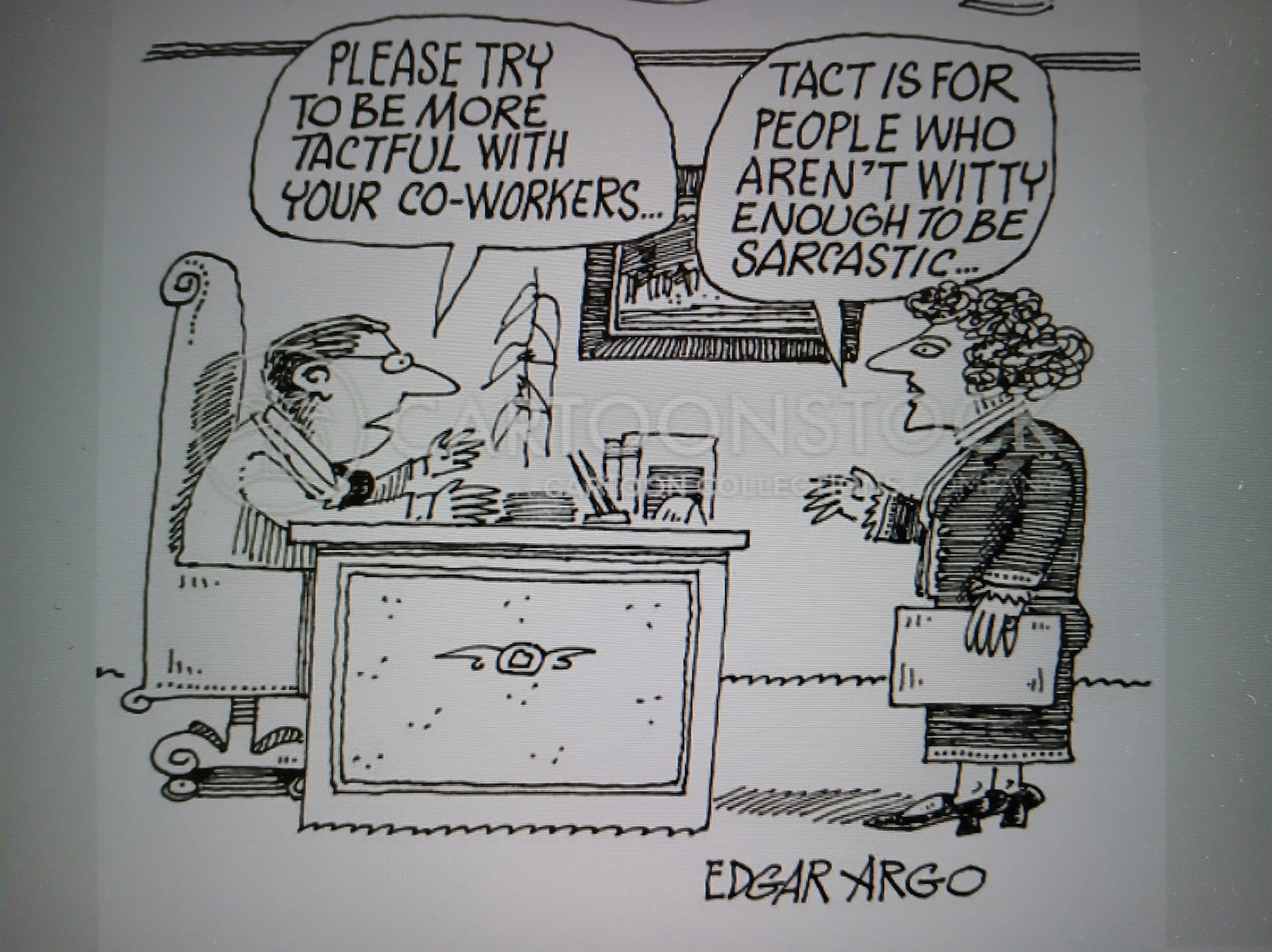
Allow me to end with a humorous cartoon regarding tact.


THE EFFICACY OF MODEST WISDOM


THE EFFICACY OF MODEST WISDOM


(Foreword: This article is aimed at exhorting corporate officers who aspire to be top-echelon leaders. Astute leaders hone in themselves prudence coupled with modesty through proper structured training, sufficient work exposure (varied experiences), and having undergone different life (personal and work) trials. In simpler words, “genuine” leaders exude modest wisdom.)


WISDOM – a short 6-letter word that many individuals know in plain understanding, but without grasping the wide comprehensive perspectives. Sound confusing? Not surprising if you readers feel so.....as wisdom itself is an elaborate mental frame that extends to holistic parameters, encompassing various related elements.


The best definition comes from Aristotle, a historical renown Greek sage (384 BC – 322 BC) revered for his philosophy plus broad knowledge across various fields such as physics, biology, psychology, mathematics, metaphysics, politics etc. (https://iep.utm.edu). His macro narratives of wisdom is ....... knowing the right timing, using the right words, applying the right strategies, making the right decisions, for the right purposes, and for the right reasons. Profound statement, isn’t it? The adjective “right” added to the various elements reminds me of the definition of “efficacy”, which is doing the right things, in the right way, continually.


Interestingly, narratives shared by Collins Dictionary, Wikipedia, and Dictionary.Com complement the enlightenment of Socrates by highlighting wisdom as.........

* Utilising knowledge, experience, understanding, common sense, and insight (Collins).

* The ability to deal with contradictions of a specific situation (Wikepedia).

* Knowledge is knowing what to say. Wisdom is knowing when to say it (Dictionary.Com).


I like to add on to the third pointer with this adage: “Wisdom is knowing when to say it and how to say it in the right way.” In simpler postulation, wisdom much entails discretion and discernment. Wisdom also relates to the following personal attributes:


# Aspire to hone holistic perceptions concerning an important subject or issue that has bearing to the outcome (whether positive or negative), depending on the decided action to be taken based on holism, i.e. covering consideration of all interconnected factors before concluding which aspects are important.


# Notable IQ (Intelligent Quotient) level. IQ can be sharpened via intense work exposure cum undergoing training and guidance.


# A wise person also possesses the disposition of composure and calmness. Simply put, he does not lose his cool despite encountering circumstantial odds. He takes some quiet moments to contemplate on the appropriate action for embarkation.


# Willingness to listen is an added asset. Perhaps a peer or subordinate may have valid information not known to others but pertinent to the particular subject. It is prudent to hear what peers and subordinates feel about a proposal before deciding to implement; also prudent to cascade the impression to the team that their joint contributions in the name of team spirit are important to the project.


# Wise leaders are modest in portraying themselves. They refrain from unnecessary revealing their capabilities – not “blowing own trumpet”, so to speak. They win trust from others they work with via building close rapport. They recognise others’ contribution. It is about prioritising team successs over personal recognition. Modest leaders are not afraid to admit mistakes, seek feedback, and delegate when or where necessary.


Modesty in leadership is reflected by the following ways:


> Enhances team dynamics and collaboration. Valuing inputs or contributions by others lead to teamwork, instilled by a shared sense of purpose. A modest personality realises his strengths and shortcomings, but harnesses the strengths (for positioning forward) in an unassuming manner whilst seeking ways to fine tune the shortcomings. He does not show off his acumen unnecessarily. Rather, he expresses his points across to others in a diplomatic tone. He secures understanding from his counterparts instead of exerting command. He draws in the win-win (“we win together” slogan) situation. Yes, a wise cum modest leader think and act for lasting objectives albeit may be gradual. He knows quick zoom-up results will only be temporary.


An example of a modest wise people’s leader in history is Mahatma Ghandi, who was instrumental in paving the way for India’s independence from British rule. According to John Mattone Global (https://johnmattone.com), Ghandi’s legacy expounds leading change through non-violence. He championed non-violent resistance to the British rule, proving that authentic leadership is about influence rather than control. He believed that a leader must live by example, choosing a service life over material wealth despite being born into a well-off family and a lawyer by qualification. His servant leadership approach was not about personal power but to serve the people, at the same time also empowering others. He was able to inspire unity across religious and social divisions. He was a good communicator who knew his strengths and weaknesses inside out.


I now conclude by sharing some quotes of wisdom by Ghandi and two other sources......


(Ghandi): ** There goes my people, I must follow them, for I am their leader. ** A sign of a good leader is not how many followers you have, but how many leaders you create. ** Strength does not come from physical capacity. It comes from an indomitable will. ** The weak can never forgive. Forgiveness is the attribute of the strong. ** The best way to find yourself is to lose yourself in the service of others.


(BrainyQuote): ** A superior man is modest in his speech, but exceeds in his actions. ** Modest doubt is called the beacon of the wise.


(Socrates): ** The only true wisdom is in knowing you know nothing (meaning – acknowleding one’s ignorance is the starting point for intellectual enquiry on a subject).


PROACIVITY - KEY ESSENCE FOR ASTUTE PERFORMANCE


PROACTIVITY – KEY ESSENCE FOR ASTUTE PERFORMANCE


Foreword: The contents of this topic are geared for attention of incumbents holding senior management positions, or aspirants eyeing this ambition. First, let us delve into the word “proactivity” to comprehend its efficacious attributes. The nearest elaboration of this word is.....active anticipation of possible upcoming scenarios, issues, needs, developments, changes. It relates to soundness of near-future actions for work purposes that contribute to astuteness. Being astute refers to the ability to vividly notice and understand situations or events, with the ability to plan ahead appropriate actions for reaping coveted positive results. Do you see the strong link of proactivity with astuteness as joint attributes? The link relates to mental sharpness!


Proactive acumen translates to several several advantages, viz.


* IMPROVED PROBLEM SOLVING – Able to address the incoming issues before escalating to become problems.


* ENHANCED PRODUCTIVITY – Planning ahead enables a corporate leader to achieve higher production and efficiency levels.


* BETTER DECISION MAKING – Gather information and consider various scenarios, then make informed decisions.


* INCREASED RESILIENCE – Able to navigate uncertainties, thus implement safeguards.


* CAREER SUCCESS – Better performance by being more innovative.


However, being over-proactive without discretion may cause conflicts due to deviation from set procedures. An over-proactive officer has the tendency to execute on his own accord based on personal knowledge and strengths, thus may be deemed non-compliant when he deviates from the guidelines.


The other possible downsides are:


* WASTING TIME & RESOURCES – Delving too much time in anticipating the nitty-gritty elements of a project will overrun into tasks that are not vital. Being engrossed in meticulously analysing all facts relating to a project, regardless whether crucial or otherwise, may waste time and resources if many are minor factors not bearing much impact to results.


* STRAINED RELATIONSHIP WITH OTHERS – When an officer is bent to prove he is more equipped with knowledge and facts than other counterparts, his actions may likely lead to misunderstanding.


It is thus important that discernment should be exercised when manifesting proactivity.


A proactive mindset entails the following attributes:


* SET CLEAR GOALS AND PRIORITIES – Deploy the practical SMART process. S = Specific. M = Measurable. A = Achievable. R = Relevant. T = Time-bound.


Specific goals are clearly defined with no ambiguity of specific items to be achieved. Goals must be coupled with measurable criteria which facilitates progress to be monitored and assessed. There is no point setting far-fetched targets that are not realistic in relation to available resources or timeframe. What are aimed at for attainment will not be meaningful if not relevant to company’s vision and mission. And proper goal setting must be in accordance with the defined timeframe table. SMART goals are deployed for personal development as well as corporate strategic planning, which support individual and organisational growth.


* ANTICIPATE FUTURE NEEDS/ISSUES & TAKE PROACTIVE ACTION – Take appropriate actions to meet the needs/issues in advance as the preemptive measure. Plan ahead. Take timely actions – do not wait.


* STAY CURIOUS, BE INITIATIVE & ANTICIPATIVE – Eager to learn. Embark to think out of the box; not contended with the “business as usual” scenario underpinned by normal existing work processes. Aware of new developments that may triggeer changes to the business or workflow.


* SEEK FEEDBACK – Inputs from peers and subordinates for their perceptions on the efficacy of the implemented proactive measures. Peruse the feedback for periodic ongoing assessment of progress attained.


Now, we look at the proactive leadership of Alan Mulally, the former CEO of Boeing and Ford. He led both corporations to overcome financial difficulties. For example, at Ford, he initiated a massive cost-cutting plan. He instituted LEAN manufacturing principles. He empowered team members to take initiatives toward problem-solving. He acted before the financial situation took a downturn (to near bankruptcy) by restructuring the company, which then led Ford to its best profitability by 2010. Innovative vehicles were not reduced, including the introduction of the first aluminium body pickup truck. Mulally emphasises on collaboration, open communication and a shared vision. His “One Ford Plan” and “One Team” mission inspired all people in Ford to work together across the company. He put people first before everything else, gave them tools, set clear expectations, and cared for them.


At Boeing, the “maverick” leader led the development of Boeing 777, the first all-digital airplane. The 787 Dreamliner model (launched in 2004) used composite materials, making it lighter cum more fuel efficient, with advanced aerodynamic design, and equipped with the latest technology. Additionally, the model improved cabin air quality, enhanced lighting, as well as reduced noise and air turbulence, hence catering for passenger comfort. Yes, “Dreamliner” was the right adjective description.


Concluding Statements


If a senior officer holding an important position continues to do the same things in his daily tasks and expects different results, that will be wishful thinking!


He needs to proact in order to move forward. Without proactivity, there is no prompt effective activity. Without prompt effective activity, there is no actualisation of coveted productivity. Without actualising the coveted productivity, he has failed in his assigned responsibility.


Confucius, the revered historial Chinese philosopher, penned many words of wisdom on proactivity, including:


* The superior man, when resting in safety, does not forget that danger may come. When all is orderly, he does not forget what disorder may come.


* Study the past if you would define the future.


* He who learns but does not think is lost! He who thinks but does not learn is in great danger!!


Now, let us mull on a few power quotes of another prominent historical Chinese philosopher who also served as military strategist during the late Zhou Dynasty. Though his “Art Of War” manual was for military pursuit advantage, it may be perused to combat business competition. Here are a few relevant advices:


* More planning shall give more chances of victory, while less planning, less chances of victory. So how about totally without planning?


* Confirmation of the terrain is the soldier’s best ally in battle. (Meaning: Understanding the overall business terrain will provide the competitive advantage.)


* ......In war, there will be no constant condition. Thus he who can modify his tactics according to the enemy situation shall be victorious and may be called the divine commander. (Meaning: Competitive environments change from time to time. A corporate leader who can devise varying strategies to suit the changing environment at hand shall gear up the winning edge over competitors.)


* ........A general who treats his soldiers like his own beloved sons will have their willingness to die for him. (Meaning: A leader who puts his people’s interest first will acquire the dedication of his team to ensure success of his mission.)


To wind up this article, I encourage you to click on https://youtu.be/RS72CoeZ6s8?si=EdhZh5I1fY_agsIs for the video recording on “How To Be Proactive” by Brain Tracy. (Brian Tracy is motivational speaker, author, Chairman/CEO of Brian Tracy International.)


Happy Proacting!


Powered by Blogger.