Malaysia's Vision 2020


 M’SIA’S  VISION 2020: WILL THE JOURNEY TO THE DESTINATION BE SMOOTH?

Of late, over the past two weeks or so, the subject of Malaysia pursuing the ambition of becoming a developed and high income nation by year 2020 has re-emerged in the fore news.  I can understand why………with the 13th General Elections (GE) slated to take place very soon, positive news about the country will lend some weight to the chances of Barisan Nasional (National Front) in its pursuit to retain yet another term as the ruling central government.

The media have reported the government’s optimism of attaining the coveted status eight years from now. Some economic pundits have also expressed positive comments about the development programmes embarked by the government, albeit without explicitly pinpointing their views on the probability of the vision being achieved.

Prime Minister Datuk Seri Najib Abdul Razak very recently proclaimed his “dream” of Malaysia becoming the first Islamic country to attain the status of a fully developed nation; however he was quick to add that this could only be ensured if there is no change in the country’s leadership. In a live television speech to launch the Government Transformation Programme (GTP) and Economic Transformation Programme (ETP) annual reports held just slightly earlier, he was quoted by New Straits Times that the country needed a competent driver - needless to say he was referring to the Barisan Nasional which is now driving the projects and ideological initiatives listed for implementation under the New Economic Model (NEM), GTP and ETP.

Deputy International Trade & Industry Minister Datuk Mukhriz Mahathir said (around the same time) after launching a seminar that Malaysia was on the right path in the transformation toward a high income nation. Although acknowledging some analysts’ views that the going might be a bit tough in view of the crisis in the US and Europe and some parts of East Asia, he said the government was diversifying to other markets, like the Middle East, instead of being dependent on traditional ones.

Suddenly, attention seems to be shifting to “domestic demand, or “domestic consumption”, or “domestic spending” (which can be used interchangeably) as the new pivot for growth. Why? As some economists have pointed out, domestic demand would be expected to drive expansion because of a slew of goodies rolled out by the government, e.g. pay increases for 1.4 million civil servants this year between 7% and 13%, the minimum wage policy for 3.2 million workers in the private sector, the mega projects, other generous handouts etc. But all mentioned their cognizance of the precarious external risks involving the continuing global economic concerns that may pose as pullbacks with regard to the desired local growth trajectory in the next eight years. 

As Bank Negara (Central Bank) Governor Tan Sri Dr Zeti Akhtar Aziz put forth her frank views to the press corps on the release of the bank’s 2011 annual report on March 21, 2011:

“In our assessment, domestic demand has continued to remain strong. It has expanded by more than six per cent but the external environment remains challenging and this will affect our economy……….If these positive trends continue, then the growth will be at the upper end, but if it takes a turn for the worse, it will be at the lower end of the range.” She added that Malaysia had to deal with external developments to avoid any financial upsets.

Will Malaysia ultimately materialise the vision by 2020? How great a probability of success as we see it “from where we are……….with what we have……..by how we are ushered, now”?  Personally, I acknowledge the slew of initiatives under the NEM-GTP-ETP grand store will provide impetus to pep up economic activities essential for GDP growth, notwithstanding the costs involved and level of implementation efficacy. For example, the joint-venture projects (with foreign stake holders) in  Iskandar regional development area, if all implemented successfully, should add hype and buzz to the people in the state of Johor. But will such projects suffice to bolster efforts to hit the noble end in mind set for the nation? Second question is, can domestic demand suddenly take over to become the dominant scorer of goals?

I want to be objective in my presentation, which should be based on facts and not on other inclinations. Two pertinent facts – which I think you may agree with me – are:

1.       1. NEM-GTP-ETP, born by the current ruling government, will be relevant as long as there is no sudden change in government policies or a change in the government structure before 2020.

2.      2.  Continuing global uncertainties, especially in the US and Europe, will invariably have a bearing to Malaysia. Any further major economic downturn will impact the supply chain, both export and import wise, for Malaysia. Like it or not, our GDP growth still hinges to a significant extent on global economic trends. Malaysia is still an export-oriented economy.

Allow me to recapitulate the key growth factors outlined by NEM-GTP-ETP for attaining developed nation and high income status. They are:

·         Growth Factor 1: Six per cent Gross Domestic Product (GDP) growth per annum.

In 2010, GDP growth was 7.2%. In 2011, it was 5.1%. As what the media reported on Tan Sri Dr. Zeti’s media briefing, the Malaysian economy is expected to grow by 4.5% this year. Asian Development Bank (ADB), in its latest report, predicted Malaysia’s GDP growth rate for 2012 to moderate to about 4% before quickening to 5% in 2013. World Bank, in its latest report, projected 4.6% in 2012 and 5.1% in 2013.On average, including the good score in 2010, the expected average growth rate from 2010 to 2013 would be below the average annual target of six per cent. Could Malaysia chase up the GDP scores from 2014 onwards in order to hit the average 6 per cent growth? Would the global economic outlook be much brighter after 2013? As the Bank Negara Governor rightly put it, if recent improvements in the US and resolution of debt issues in Europe could hold, then the growth will be at the upper end of the range, but if it takes a turn for the worse, it will be at the lower end of the range. Which direction of “if” do you think would occur? I shall leave this question for your own ponder.

·         Growth Factor 2: Exports grow 10.6% per annum.

The Edge reported a decline in Y-0-Y export growth from 9.9% in 2010 to 3.7% in 2011.  Meanwhile, Minister of International Trade & Industry Mustapha Mohamed was quoted to have said that export growth was expected to be around 5% - 6% in 2012, being underpinned by intra-Asian demand.  World Bank was slightly more optimistic - it anticipated exports to pick up from 3.7% last year to 6.6% this year and 9% next year. Whichever source of statistics we prefer to refer, apparently the targeted growth rate of 10.6% per annum may seem far to reach if the global economy at large continues to remain uncertain for a while longer. Perhaps, this explains why the Government now decides to rely more on “domestic demand” as the alternative to export growth?

Exports like commodities, oil & gas, palm oil, rubber, semi-conductor components etc. still contribute significantly to the economy. Exports represent a major component of GDP. The country could be adversely impacted either by a fall in commodity orders or a slowdown in global economic activities. The pertinent question is, can a push in domestic demand cover up the shortfall in exports versus the annual target growth should the prevailing global situation persist?

·         Growth Factor 3: Private investments grow 12.8% per annum.

2011 did well in this area, with a score of 15% growth, thus surpassing the target. A total of RM94 billion was recorded, which was the highest in 5 years from 2007. Moving from 2012, the prospects may be different. Malaysian Industrial Development Authority (MIDA) in its portal anticipated private investment to grow 8.3% in 2012. Historically, private investment growth in the last decade (2000 – 2010) recorded an average rate of 6.7% per annum. Can the scores from 2013 onwards be spurred up in order to hit the annual target? Perhaps so, if investments from foreign private players continue to pour in, and more joint ventures could be successfully created in the next eight years. But if more global uncertainties set in, would foreign investments flow into the country be stalled? Again, I shall leave this question for your own ponder.

·         Growth Factor 4: Per Capita Income of US$15,000 by 2020. 

The Prime Minister said at the launch of the 2011 annual reports for GTP and ETP: “We are on the correct trajectory to reach per capital income of USD15,000 in 2020.” The New Straits Times reported that per capita income had arisen to US$9,700, from US$6,700 when the ETP was launched two years ago. The latest figures show the shoring-up efforts for per capita income are progressing in good order, and it may be the only growth factor likely to hit the target by 2020. The recent handouts, the increase in salaries of civil servants, the incoming minimum wage policy, the perks for FELDA settlers, the 1Malaysia incentives like 1Sara investment scheme for the lower income group, and so forth – all these add to the per capita income, which is in essence the total national income divided by the total population. However, the more important consideration is whether the monetary incentives would greatly help to propel productivity activities that elevate the chances for reaching developed nation status, and not just merely on per capita income measurement. 

On the subject of high income, I have recalled an in-depth article which was carried in The Edge Malaysia four months ago. The writers by the name of Nungsari Radhi and Nicolas Khaw (economists) shared that of the countries which were middle-income in 1960, very few crossed over to the high income level in 2009. Most either remained as middle-income or upper middle income at the most.

Let’s look at some excerpts extracted from this article:

·         * Improving without significant structural change will still keep the economy on the same trajectory albeit on a steeper curve, but it will not result in a discontinuous jump to a higher-level trajectory. Economies that cannot find that discontinuity stay on the same path.

·         * If we consider countries that have made the jump, a common pattern emerges. South Korea made its jump by pursuing heavy industries before other countries in the region, save Japan. Taiwan did it by hopping on the emerging electronics industry. Singapore exploited its location as a go-between Japan and the Middle East as well as being open to the concept of importing highly skilled foreign talent; it moved away from its colonial logic of a port serving a regional hinterland.

·         * What these three countries have in common is the willingness to be innovative by pursuing a new industry that latches onto a global trend, and from this willingness, the ability to diffuse this innovation as widely as possible. Diffusion of innovation means spreading the benefits of innovation economy-wide or removing barriers to the expansion of innovation. 

Meanwhile, according to Frederico Gill Sander, the World Bank’s senior country economist for Malaysia, the country needs to create more “modern” jobs and modernise the labour markets in order to become a high income economy. Firms need to derive their competitiveness by the productivity of their workers and must be willing to pay for talent. He said Malaysia could complement its talent base by recruiting scarce skills from abroad until it gets it structural changes in place.

So, will Malaysia achieve the noble end in mind in year 2020, i.e. full developed nation and high income nation (both together)?  I have rendered some concrete facts (above) for you to reflect upon and then form your own opinion. 

Yes, I hear you………I should express my own opinion on the subject as the scribe of this article. Well, objectively, I must recognise the Government for implementing multiple initiatives under the big NEM-GTP-ETP store in line with the vision. I must acknowledge our Prime Minister and team are trying what they feel could and should be implemented. I would anticipate Barisan Nasional retaining another term as the elected central government in the 13th GE and thus follow through the programmes. Apart from the level of effectiveness of the programmes, I guess Lady Luck also has a role to play in the next eight years. Let us hope the world economy would not drag on with bearish sentiments for long but return to bullish mode soonest possible. 

Best Regards.


THE BEHOLDING SIGHTS OF GUILIN & YANGSHUO (Part 2)

(#NOTE: PART 2 IS CONTINUATION OF THE PHOTO SERIES FROM PART 1 OF THE SAME WRITE-UP. PLEASE REFER TO THE NARRATIVE SCRIPT IN PART 1)

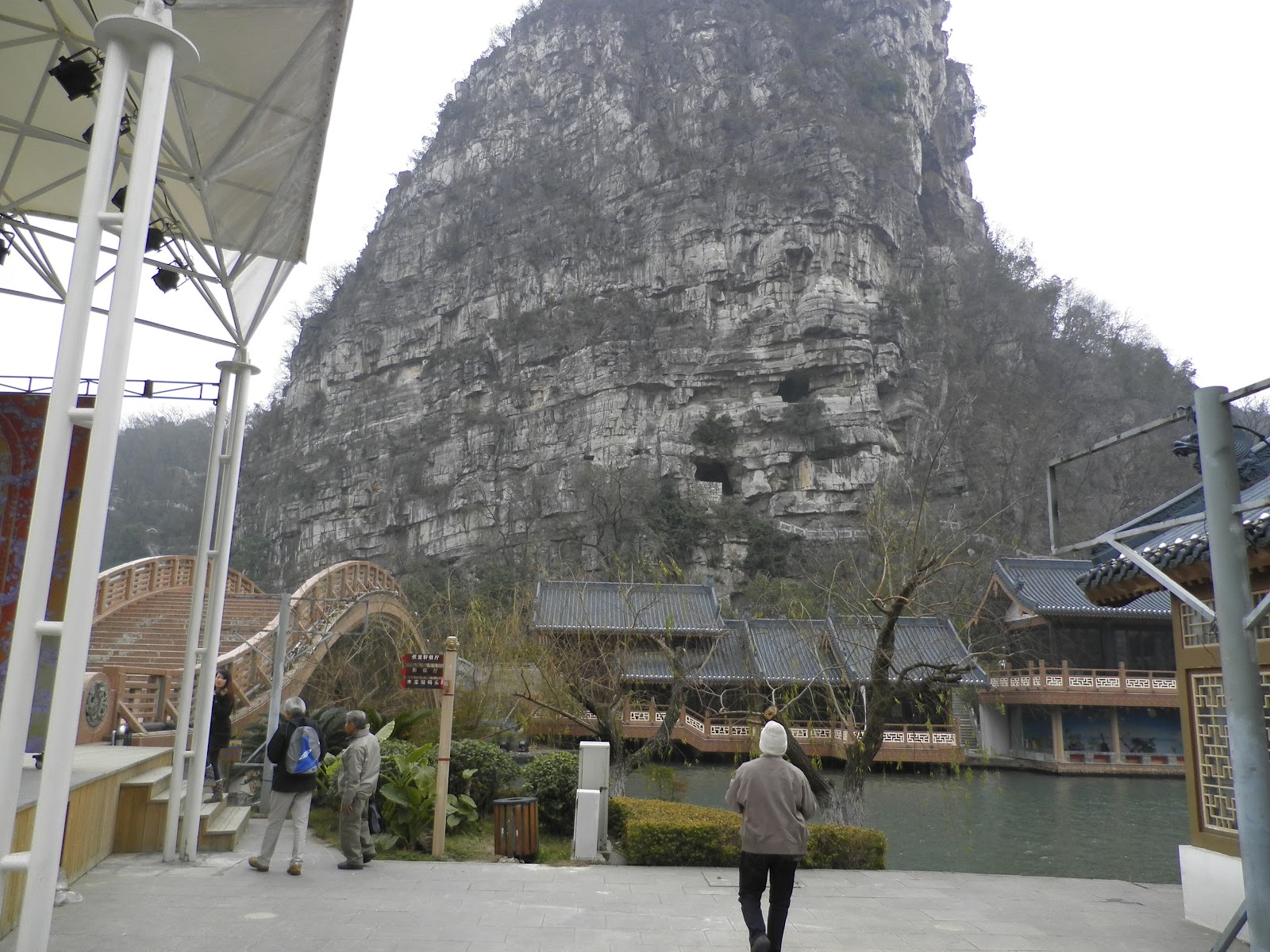
(Enjoying the scenic views onboard the ferry plying to Yangshuo from Guilin. Can you "perceive" resemblances of 9 white horses? I could perceive 1 horse - the white patch on the immediate right of the centre patch)
 (Picturesque scene of our bamboo rafting expedition along Yulong River. Below: The 700-year-old Yulong Bridge still serves farmers in this countryside)
(Double images on land and water - taken from our bamboo raft)
(Above: A unique formation in Silver Cave that appears to contain silver deposits; two other beautiful and colourful formations - like a cave fairyland!)
(Take a boat ride to view landscapes in Shiwai Tao Yuan. Next 2 pictures below:  Vegetable plots, old traditional buildings & protrude-shape mountains; Serene scene in Shiwai Tao Yuan)
(Charming girls in traditional costumes who greet visitors in Shiwai Tao Yuan)
(Above: Traditional Zhuang house in Liu Sanjie Grand View Garden; How a Zhuang woman bind up her hair into a natural turban)
(The grand 1,500-year-old tree in Bayan Tree Scenic Spot)
(Part of the show of Impression-Liu Sanjie night water concert)
(Hot and delicious for breakfast - from a street stall in Guilin. Below: Some sumptuous dishes from a restaurant)


ENDS....


THE BEHOLDING SIGHTS OF GUILIN & YANGSHUO (Part 1)

Guangxi Province in China is well known for its rustic countryside environment that is exuded by the charm of unique protrude-shape mountains, soothing rivers, luxuriant greenery and peaceful lakes. In addition, sites that manifest elements of historical eminence and cultural prominence make holiday trips to the province more variedly interesting.  And topping up to the attractions are caves housing amazingly natural “artistic” limestone formations that capture the awe of visitors. 

My friends and I – eight of us – returned home to Malaysia from an eight-day trip at the end of February, feeling greatly satisfied of our worth-money-spent experience in Guilin, the main city of the province, plus the smaller and quieter Yangshuo. We opted for our own accommodation and itinerary arrangements instead of a packaged tour. Not counting the air-fare which we booked on Air Asia’s special offer rate months ahead of the planned trip, my share of the joint expenses for good food, cosy hotel accommodation and memorable sight-seeing was around RMB2,800, or equivalent to RM1,400.

GUILIN:

An hour of boat ride along the stretch of Li River which penetrates the heart Guilin was a good refreshing start upon flight touchdown. Apart from some scenic sights, like Elephant Trunk Hill, activities linked to the river appeared to be part and parcel of the city scene there. Some residents were seen doing their chores around their boat houses berthed along the river banks. Fishermen in small rafts scoured the river for their catch of the day. The tree-shaded esplanade overlooking the river was occupied by people engrossed in leisurely activities like card games or physical exercises.

Guilin had many attractions to offer us. But I can only give an account on our selection.

A key site which should not be missed out by visitors is Solitary Beauty Peak & Prince City Scenic Area. The historical Prince City, which encompasses the famed peak, was established in the Ming Dynasty (14th – 17th centuries) era. Built from 1372 to 1392 AD by Zhu Yuangzhang, the first Ming emperor, for the Prince of Jingjiang, it is older than the Forbidden City in Beijing. Fourteen kings lived in the enclosed haven till the end of the Ming Dynasty. Sun Yat Sen, the “Father of the Nation”, stayed there in 1921 before his demise four years later.

Going up the peak was a challenge for us, especially me and another five friends who are already senior citizens. We had to climb more than 300 steep and winding concrete steps. At 216 m above sea level, we witnessed a panoramic view of Guilin. A plaque prominently commemorates Sun Yat Sen’s philosophical remark when he first reached the peak at night. His quote: “There is no distinction between difficult and easy things. If you try, difficult things will become easy. If you give up, easy things will become difficult. Climbing Solitary Beauty Peak at night is just like carrying out the Northern Expedition and there will be a lot of difficulties. But we cannot stop making preparations because of that.”

The other visits in our Guilin itinerary were:-

·         Fubo Hill: Within the city centre, the peak of the hill is just slightly lower than Solitary Beauty Peak, but equally exerting to climb up the flight of steep and winding steps. One side of the foothill drops towards Li River and curbs water flow, thus causing the formation of a deep bay. Visitors can take a boat ride round the bay. At the hill’s cave mouth that opens up to the bank of the bay is a stalactite rock (hanging from the ceiling downwards) that almost touches the ground but just short of about an inch. Legend has it that General Fubo of the Han Dynasty swung his sword at the bottom part of the rock and sliced through to create a crevice, thus putting awe in his opponents who were about to attack his troop. Because of his feat, the opponents retreated. This explains the name given to it – Sword Testing Rock. I was also astounded by the numerous fine statues carved out from the wall of the cave.

·         Li River Gudong Scenic Area: About 25 km away to the outskirts, it envelopes the environment of a national park or forest reserve beside a river. Hosting visitors are waterfalls, green lakes, luxuriant forest trees and shrubs, and varying landscapes. This large “back to nature” park is also a popular spot for adventurous outdoor challenges like scaling up a waterfall against plunging waters by holding on to a chain line at one side of the waterfall cliff.

·         Yushan Park: The place is said to reminisce the historical birthplace of Guilin’s culture dating back few thousand years. Inside the park is Yu Mountain, named after Emperor Yu after his visit to the south. To commemorate him, a temple – Shun Temple - was built on the mountain. Just at the entrance to Yudi Temple in the vicinity of the park is a bronze statue, in sitting position, of Emperor Yu’s younger brother Xiang. History records him as the inventor of Chinese chess. Myth says that the statue was blessed when it was erected, and visitors who touch the head of the statue would be endowed with blessing of intelligence.

·         Sun Pagoda & Moon Pagoda: Located strategically on Bayan Lake, the pair stands as beautiful structures of Guilin City centre. The Sun Pagoda, with nine storeys, is the tallest pagoda built with copper in the world. An underwater glass passage enables visitors to walk from one to the other.  At night, with illuminating lights, both glitter majestically – the Sun Pagoda shining in gold colour while its twin dons the silver. The pair was a perfect subject for my night scene photo-snaps.

·         Daxu (ancient town): One of the renowned ancient towns in Guangxi Province, Daxu is about 25 km away from Guilin. It has more than 1,000 years of history, being established in early Song Dynasty era. Most of the residents whom I saw while browsing around the old, narrow and dim houses lined along the sole 2.5 km long street were elderly people. Li River cuts through the town but the ancient cross-over arched bridge built in the Ming Dynasty era is still in robust condition to serve as the link of the two sides. No wonder it is known as Longevity Bridge.

YANGSHUO:

To reach there from Guilin and back, there were two options open to us – either by bus which would take us 80 minutes one-way journey on a bumpy road, or by ferry plying calmly along Li River but at time span of four hours. We opted for both – by ferry to Yangshuo, then by bus back to Guilin. We did not want to miss the opportunity of experiencing the river ride plus its riverine scenery, yet able to save some time returning to Guilin by bus.

Our two-day itinerary in and around Yangshuo was even more memorable. My first thumbs-up was the bamboo rafting experience on Yulong River for two-and-the half hours. Comparatively, the ferry ride from Guilin to Yangshuo was pleasant and refreshing, but the bamboo rafting feel was magnificent and fascinating! Our expedition began from Chao Yang pier on four rafts (two passengers and one “pilot” manoeuvring with a long bamboo pole on each raft). Except for a few low rapids, the rafts glided most of the time on calm current flow, rendering us a relaxing mood to capture the wonderful countryside scenery and riverine life with our cameras.  We took a short break at the 700-year-old Yulong Bridge which is still being used by farmers to cross from one bank to the other. The serene countryside and river environment against the backdrop filled with wavy mountainous outline; the fresh cool air; the reflections of farm houses and trees or shrubs illuminating on the water at the sides of the river; the scene of fishermen at work with fish traps; country folks washing clothes at the banks; ducks floating; and birds flipping around or chirping – all these instil feelings of peaceful euphoria into me. 

Another fascination to me was the Silver or Yinzi (meaning silver in Chinese) Cave. “Mystifying” would be the right descriptive word. It was my first time that I beheld a wide spread of unique karst cave rock shapes in the form of stalactites, stalagmites, stone curtains, stone flowers and stone pillars. Some illuminate specks of slivery glitter as shone by floodlights, which explains the name given to the cave. What I saw lent me the feeling that I was in a cave fairyland filled with rocks shining out bright colours.

Our Yangshuo itinerary included:

·         Shiwai Tao Yuan: It is also known as Shangri-La or Xanadu, which are near synonyms in English. The name in Chinese means “land of peach blossoms”, indicating peach trees thrive there. As a theme park depicting a cultural village of minority ethnic groups, we first took a short boat ride on Swallow Lake to view the scenic surroundings. On land, we saw model villages, traditional buildings, craft works like weaving, art pieces, traditional dance and song performances, and ethnic cultural traits.

·         Liu Sanjie Grand View Garden:  The name of the site extols a legendary heroine of the Zhuang ethnic group called Liu Sanjie. As the legend goes, she was well known as a folk-song singer while also championing for rights to uphold justice and fight against suppression. The people in Yangshuo believe Liew Sanjie actually existed. To me, this place is similar to a smaller scale of Shiwai Tao Yuan from the perspective of traditional and cultural elements but embellished with folk songs of the Zhuang ethnic group sung by performers while we were there.

·         Bayan Tree Scenic Spot: Still standing gloriously with full foliage is the 1,500 year-old ancient Bayan tree, spreading out a canopy of more than 1,000 sq m in area. Its trunk of 7.1 m in circumference soars up to 17 m. The tree, looking like a giant bonsai from a distance, was planted in the Sui Dynasty era around 6th century.

·         Impression-Liu Sanjie Concert: Visiting Yangshuo would not be complete without attending the grand night water concert. Shanshui Theatre is an outdoor venue holding a capacity of 2,000 seats. The “water stage” is on a segment of Li River facing several mountains not too far away which serve as the silhouetted background.  Except on rainy days, the show is played daily due to demand from continuous flow of visitors to Yangshuo, including Chinese from other provinces. I saw a full cast of a few hundred performers synergising their moves flawlessly on water and on numerous boats. The outstanding essence of Impression concert, in my opinion, was its impressive choreography arranged by Zhang Yimou, the director who choreographed the opening and closing ceremonies of the Beijing Olympics in 2008. Colourful floodlights added in the limelight. Although the storyline was not evident, I could guess the character of Liu Sanjie was incorporated in the entire show.

Food in Guilin and Yangshuo suited our palates well. And all the chicken dishes we tasted were succulent. In Yangshuo, we also relished the exquisite “beer fish” (fish braised with beer-blended savoury and slightly spicy sauce) available in most good restaurants.  And prices were very reasonable…..an array of eight to nine dishes, together with four bottles of local beer, for dinner in a posh restaurant cost us around RMB300 or less – around RMB30 or RM15 per head for our group of eight friends.

(Taken from Guilin city-Li River cruise)
(Common sight at Li River in Guilin city. Local fishermen on rafts scouring for fish with trained birds; Close-up of Fubo Hill)
(Chengyun Palace in Prince City)
(Sun Pagoda on the right and Moon Pagoda illuminating outstandingly at night)
(Want to snap photos with them for 5 yuan? Note the two pagodas as the background)
(Taking the challenge striding up Fubo Hill - slow and steady by real tiring; The fresh forest environment in Li River Gudong Scenic Area; A waterfall in Li River Gudong Scenic Area, below)
(Entering Yushan Park.........at the back is Yu Mountain)
(One of the relic stone sculptures in the cave of Yu Mountain. There are many of such relics there)


(The old "dragon" Bayan tree in Yushan Park. Note the long outreach of the main branches in the shape of dragons)
(Two pictures of Daxu ancient town. People - more of the elderly folks - are still living there, most of them from generations. The second picture shows the gateway to the more ancient part of Daxu)
(Longevity Bridge in Daxu is still robust to serve people who wish to cross Li River. Below: Home-made chilli stuff - both wet and dry - are available in many varieties)

(#NOTE: MORE SNAPSHOTS POSTED IN PART 2 OF THE SAME WRITE-UP. PLEASE SEE PART 2)


Updates On The US Economy & The Greenback


While the unemployment rate in the US is improving (8.3% in March, 2012), personal consumption expenditures index has arisen, and more Americans opine that the national economy is getting better, Bloomberg has reported Federal Reserve Chairman Ben Bernanke recently saying as follows:-

·         *US economy was operating way below its level prior to the financial crisis.

·         *Increase in household spending was needed to sustain the expansion.

Apparently, other than a general statement, Bernanke stopped short of giving indications what he had in mind in respect of recommendations.  Compared to him, the Federal Open Market Committee was more direct to point out that subdued inflation and high unemployment still warranted holding the benchmark interest rate to near zero at least to late 2014. 

Mark Gertler, an adviser to the Federal Reserve Bank of New York who has co-written research with Bernanke, said that inflation was contained, employment  growth was picking up, and controls were at the right setting . He also said the following:-

·         *The Fed’s policy was always subject to change in line with news changes.

·         *Seemed like a stimulus, at least from the Fed, was not appropriate for now.

Some policy makers in the US say the Fed should hold off from more accommodation as the economy rebounds.  James Bullard, the Federal Reserve Bank of St Louis president, said that with policy seemingly to be on pause, “it may be a good time to take stock of whether we may be at a turning point.”

Latest economic reports lent credence that the world’s largest economy was gaining momentum.

Reading in between the lines of the above statements and contents, I am the more convinced than before that the idea of another round of quantitative easing (QE3) is indefinitely shelved behind closed doors….at least not for this year.

I am curious enough to wonder why Bernanke preferred to make a non-committal statement without referring to any directions in terms of recommendations or actions. Just what was actually in his mind by painting a sketchy picture without the finer details? Was he hinting that he was harbouring some plans in his heart but would not reveal what these were for the moment? Or was he merely suggesting that fellow Americans should not expect the lean times to be over that quickly, and that it might take a while longer for a real revival to materialise. Well, only he himself knows best what should or could be in store for further actions if needed. 

My good friend CS Chan, who is a close observer of global economic trends and a fund manager himself, has shared with me his personal views. Chan feels that the Federal Reserve may have run out of tools. Already, US$1.6 trillion in excess reserves had already been rolled out and yet not able to aggressively spur lending or job creation, so what good can another US$1 trillion do? Perhaps, to keep the game rolling on, Bernanke has to project that the central bank possesses the tools, but without providing details or signalling when or whether policy makers might deploy them.  In the chairman's speech made on Aug. 26 last year to central bankers and economists at a forum, he said: “In addition to refining our forward guidance, the Federal Reserve has a range of tools that could be used to provide additional monetary stimulus.” To be fair, the Federal Reserve will try something. But like me, Chan is not sure what the “something” will be. Till now, it is still very much about different pundits gazing at different economic crystal balls to predict the likely turn out of events in the world’s dominant economic power by single nation. 

As for the greenback, Chan feels USD should strengthen much against EUR, YEN and GBP in the time frame of this year as the latter three are already wounded by their own problems. Thus, unless US shoots own self, USD should strengthen against the other three within this year, possibly by 3Q. 

Chan is looking for levels: EUR/USD below 1.2; USD/JPY above 100; GBP/USD 1.5 (he is not so bearish on GBP as it is already at low level). 

His views: The Spain problem (even Italy) may re-surface by then. New bailout/”haircut” speculation may heat up. The other pertinent question would be how much German growth could be affected. These could lead to a weaker EUR. As for Japan, the banking sector is not functioning as it should and consumers are behaving like “ostrich”. GBP has been negative for 2 years. The flow to push it down has already accumulated.

Best regards to all.

·         *Note: My appreciation to Chan for sharing his views.

·         *Special Note: The personal views expressed in this commentary are based on own analysis; therefore these should not be taken as guaranteed actualities or events to take place from henceforth.

Powered by Blogger.