RAYMOND HO'S SKETCH ART


INTRODUCING RAYMOND HO & HIS SKETCH ART

Hi to all readers. Any of you keen to take up “scenery sketch art” as a hobby?  If yes, then let me introduce my pal Raymond Hoh, a sexagenarian (age category 60 – 69).

Raymond was in Yunnan Province , China together with me and 12 other friends for holiday in the third week of March when I incidentally discovered his hidden talent. We had just finished lunch at the restaurant nearby the foothill of Lijiang’s Jade Dragon Snow Mountain. While the rest were relaxing with coffee or chit-chatting, Raymond went out to the balcony and sat there, facing the view of the mountain.  I went to him to keep him company and then witnessed that he was inking a sketch of the mountain.

Within a jiff of about 10 minutes, the sketch was nicely pieced up. It was awesome, and I was surprised of his “silent” talent which he harboured to himself without talking about it in the past. Quite reluctantly, he agreed to my suggestion that I give him a bit of publicity in my blog. Here are the contents of my interview with him:

*Question:  What is the technical term for this kind of sketch art?
Answer:  Not sure……I just call it free hand sketching.

*Question: When did you start this hobby?
Answer: About 40 years ago.

*Question:  How did you develop an interest in this art?
Answer:  After completing my university education, I went hitch hiking in Europe for a year on a very tight budget. I didn’t have spare money to buy postcards to send home. So, I started to sketch scenery sites that I appreciate on white sheets and mail them as postcards to my family. Later, I turned some into greeting cards to my friends. They seemed to like the “hand-made” cards.

*Question: What  utensils/equipment do you use?
Answer: Just a fine felt pen plus an album containing blank thick paper.

*Question: What kind of training is necessary to develop this hobby? Did you take up a course? Who was your trainer, if any?
Answer: I didn’t go through any special training or course except attending the art curriculum in primary and secondary schools.

*Question: Did you peruse any reference materials in order to groom yourself in this hobby?
Answer: No. Whenever I come across any scenery which attracts me, I sketch it down quickly.

*Question: So far, have you ever exhibited your works? If not, why not?
Answer: No. Basically, I treat it as a personal pastime and share with friends only if they appreciate this form of expression.

*Question: If other individuals are keen to get some tips from you, are you willing to share? Can they communicate directly with you via your e-mail address? Are you willing to give tuition?
Answer: Sharing via e-mail is alright for me. I don’t have time to give tuition. (His e-mail: raymondhohty@gmail.com

*Question: How long do you normally take to do a sketch?
Answer: Normally 5 to 10 minutes. At times, I might fit in the minor details, such as leaves of a tree, later at my leisure, based on my memory of the view.

Want to see Raymond’s sketch of Jade Dragon Snow Mountain? Well, here goes…….

Ray in action………

His completed sketch of the Jade Dragon Snow Mountain……….

The mountain as captured by my camera………...

Ray’s sample of previous sketch of another scenery.........

The end.


Malaysia's Developed Nation Status Ambition


MALAYSIA:  STILL AN ARDUOUS JOURNEY TOWARD THE DEVELOPED NATION STATUS DESTINATION

What is the latest progress update on Malaysia’s ambition to achieve Developed Nation status by year 2020? After the vision cum mission was launched in sync with the Government Transformation Programme (GTP) and Economic Transformation Programme (ETP) a few years ago, much hype in terms of statements by Prime Minister Datuk Seri Najib Abdul Razak and his cabinet representatives thronged the news media for some while.  However, the upbeat seems to have abated now.

From my Google search, I have traced a report in the Malaysian Insider news portal, dated June 10 2013 (eight months ago), which quoted the PM as declaring Malaysia was set to achieve the target ahead of schedule, barring unforeseen circumstances. This optimism was based on prevailing projections at that point in time, the report reported. However, there was no elaboration of details on the said projections or what the unforeseen circumstances could possibly be.

So, is the progress to-date on track or off track?

As a layman, I can relate some hard facts which perhaps may portray a sketch of the overview of how the nation is faring on the endeavour.

When the direction was first unveiled around 2010, it was specifically mentioned the gauge to hit the target would be an average of 6 per cent GDP growth till 2020. Year 2010 was the best in growth rate in the last four years, at 7.2 per cent. From 2011 to 2012, the scores fell below the 6 per cent mark – 2011 (5.1), 2012 (5.6). As for 2013, New Straits Times, in a front page article on February 13 2014, reported that the economy grew at 4.7 per cent. Going by simple mathematical computation, the average growth rate over the last four years arrived at 5.65 per cent – not too far off the 6 per cent mark.

Obviously, the nation must catch up in accelerating the economy from now onwards.  However, according to various commentaries, the anticipated figure for 2014 would remain below 6 – probably around 5. And if we take 5 as the presumed rate, then the average rate for period of 2010-2014 would be 5.52.

In order to keep in pace with the coveted overall 6 per cent growth, Malaysia has to hit an average 6.4 from 2015 till the end of 2020. The probability of achieving this does not seem remote, yet apparently quite arduously challenging in the face of a not so eventful  prevailing global recovery.

In January 2014, the International Monetary Fund (IMF) set its forecast of global growth rate at 3.7 per cent while The World Bank projected 3.2. So, can Malaysia significantly outperform the globe? Can its GTP and ETP projects successfully propel higher economic development and productivity for catching up?

While being determined to pursue relentlessly the noble cause, the Government may want to recognise a few factors which could pose some pullbacks.

First, it should recognise that of the total expenditure budget for 2014, development expenditure allocation constitutes RM46.5 billion, representing merely 17.6 per cent. Is this proportion sufficient to drive up economic and productivity levels that lend more weight to GDP growth? Should not a larger allocation be granted to support the mission?

The Edge Malaysia carried a big spread out commentary on Malaysia’s GDP growth progress in its February 3 2014 issue. Inflation would be a key risk and challenge for 2014, said the writer. Quote: “Inflation, which has been benign in the last three years, will start to climb in 2014. The commentary added that inflation would be the key risk and challenge this year. At the same time, rising household debt, standing at around 85 per cent of GDP at the end of June 2013, is a concern. Coupled with a weaker ringgit, the purchasing power of Malaysians would be reduced, thus forcing them to cut back on spending.  In essence, the emanating effect is, domestic consumption could be pulled back due to rising inflation and high household debt, which in turn could drag GDP growth.

The weekly magazine also said private investment growth in 2014 would likely remain flat, at around 14 per cent. Meanwhile, public  spending was expected to reduce comparatively to 2013.

Given a moderation in domestic demand, the nation would rely to a greater extent on exports performance. Hopefully, a weaker ringgit would bolster export earnings, which result in higher contribution to GDP. But even with improvement in exports revenue, will that be strong enough to offset the moderation in domestic demand? Is the recovery in US and Eurozone sustainable enough to give leverage to Malaysia’s exports?

In the home front down south part of Malaysia, a slowdown of property purchases in the Iskandar Development Area – the flagship development hub in the state of Johor - is expected because of more stringent conditions for foreign ownership. High-end properties purchased by Singaporeans and other foreigners have had been the prominent scenario in Iskandar but the prominence may somewhat falter. Foreign revenue from this source seems likely to ebb; the question is to what significant scale? Well, let’s see how it turns out at a later stage.

In summing up, as a Malaysian I believe the Government under the leadership of the current prime minister will do the utmost to ardently drive toward the destination according to the set timeline. It is now not a question of desire. It is also not so much a question of will. Desire and determination must be strongly complemented by efficacious strategies and management to make the magic work. 
Resources for activities that do not have much bearing to productivity should be re-channeled to initiatives that carry the positive impact. The Government must do the right things right, right now and till end of 2020. And perhaps a bit of luck is needed.

(Note:  My commentary is compiled from my own perceptions. I shall leave to readers to form opinions whether the points postulated here are plausible or not. Readers are free to agree or disagree; whichever I shall accept in good faith. So, please feel free to comment.)

THE END.

The Attractions Of Betong


BETONG: FOR GOOD FOOD, CHEAP PRICES & CLEAN COOL MOUNTAIN RELAXATION

Few decades ago, Malaysians would shun going to Betong in Thailand, a small town just a “stone’s throw” away from the common border. It was infamously linked to the outlawed Communist insurgents who used the mountainous  jungle terrain nearby the town as the clandestine enclave to escape the pursuit of Malaysian security forces. The insurgents engaged in jungle warfare tactics against the security forces in Malaysian territory. After each confrontation, they would then seep through the border to the enclave for refuge. 

When the insurgents laid down their armed struggle in 1989 and granted amnesty by the Malaysian Government, some chose to be assimilated into the Thai civilization. Mostly between late 50s and mid 60s in age now, they are either currently in business or trade as peaceful Thai citizens.

Today, Betong is a popular holiday retreat for Malaysian Chinese who seek good Chinese and Thai food, and also to relax in a cool, clean mountain environment not too far from the town – all in very affordable costs. The Malaysian Ringgit is commonly accepted by all businesses as the alternative to Thai Baht. Communication is not a problem as the Thai Chinese there are fluent in Mandarin and the main Chinese dialects. Many local Muslims speak the Malay lingo. Malaysian Chinese would feel at home although in another country.

In the third week of November, I went with close pals Lim Buck Kooi and Kok Mun Sum, along with Buck Kooi’s business associates. This was my second trip to Betong. The first time was slightly more than two years ago, in July with some other pals for “makan-makan” (food savouring) and feasting the “king of fruits” – durian (it was durian season then). 
   
In the recent trip, I had the opportunity to stay in the Winter Flower Garden Resort on highland terrain for the first part of the three-day itinerary. The average temperature at around 18 to 20 degree was pristine. Full bloomed flowers spanning the resort set a pleasing mood. The meals served by the caretakers suited our taste buds well – simple preparations but yet satisfying, especially the fresh own-grown organic vegetables. Activities available after dinner were karaoke, mah-jong and card games. 

The resort was slightly more than an hour’s drive by mini-bus from Betong town. I remembered seeing plenty of durians dangling from trees decked at the sides of the uphill road in my first journey there by MPV in 2011 – which was like a quick browse through without staying overnight – but this time the trees were devoid of the fruits because it was off season. I was wondering……..if it was in season, we could have picked some fruits along the way as there was no fencing to keep off poachers. Even in my first visit, I did not see anybody attending to the plots of land although the fruits were in abundance. Probably the trees are wild, in no man’s land?

A must-visit place which is halfway between Betong and Winter Flower Garden Resort is the Piyamid Tunnel. The entire site encompasses the former main operating camp of the Communist insurgents, with dug-out tunnels serving as refuge hidden in the upper reaches of thick jungle.Visitors can perceive how they lived and survived.

At the fringe of the town is the Betong Hot Spring in Ban Charo Parai  Village. I soothed my tired feet in the pool and then joined the other pals to relax under a tree, sipping a locally concocted herbal wine tonic, fresh coconut water and tucking in some light food bought from vendors. There is also a souvenir shop situated at the entry of the site which offers quite a good range of items at reasonable prices, including comfortable t-shirts in striking colours and awesome designs sold around 200 to 250 Bahts (equivalent to RM20 – RM25).

Now, about food……… I strongly recommend the popular Chinese Tim Sum restaurant (seemed to be the main one in the town) at the corner of Chayachawalit Road and very nearby Mandarin Hotel - where we stayed according to the second part of the itinerary - for breakfast on the third day.  The cuisine available in wide varieties was indeed satiating. Together with another two friends, the three of us "gluttonised" ourselves with 14 baskets of the wares. When we settled the bill in Ringgit, we were really taken aback – RM20, inclusive a pot of Chinese tea for three persons! We couldn’t believe it at first, so we double-checked with the owner whether he had made a mistake. We were affirmed that each basket was only around RM1. Astonishing! The same restaurant served our group excellent dinner on day 2 of the itinerary. Eight large servings for 12 people, and the bill came to only RM280. No fanciful garnishing but the "solid" ingredients exuded the the aroma of each dish.

Overall, food was good and I would say very worthwhile the costs we paid.

If you have never been to Betong and if you are a durian lover, I recommend you go there during the fruit season in the middle of the year. Unfortunately, my recent trip was off season. I remembered I paid RM2 per (good) fruit in my first trip two years ago. Out of curiosity, I checked it out with a fruit stall holder - whom I recognised as the trader who sold me organic durians last time - about the current average price this year. He told it was around RM2.50 to RM3 per fruit, depending on the size – still cheap.

Hotel rates are also comparatively much cheaper than in Malaysia. For RM80 per night on twin-sharing, you can select one of the prime hotels.

All in all, my second visit to Betong was equally memorable as the first. And all in all, it was real money’s worth.

Photos.............

Day 1:

(Duty free outlet at the Malaysian side of the common border as the first visit site in our itinerary.)
                                          (Buying local foodstuffs not available in Malaysia.)
                                                    (Taking a break in a cafe cum bar.)
                           (Is this the largest postbox in the world? Taken from a blog).

                           (In abundance during every durian season - photo taken from a blog.)


          (Trekking up to the tunnel site. There was no plank path those days for the insurgents.)
            ( Such was the original trekking terrain of the insurgents - through very dense jungle.)


        (Briefing by ex-Communist caretaker about the history of Piyamid & the tunnel links.)
                                                         (Map showing the tunnel links,)
                                                    (Treading inside one of the tunnels.)
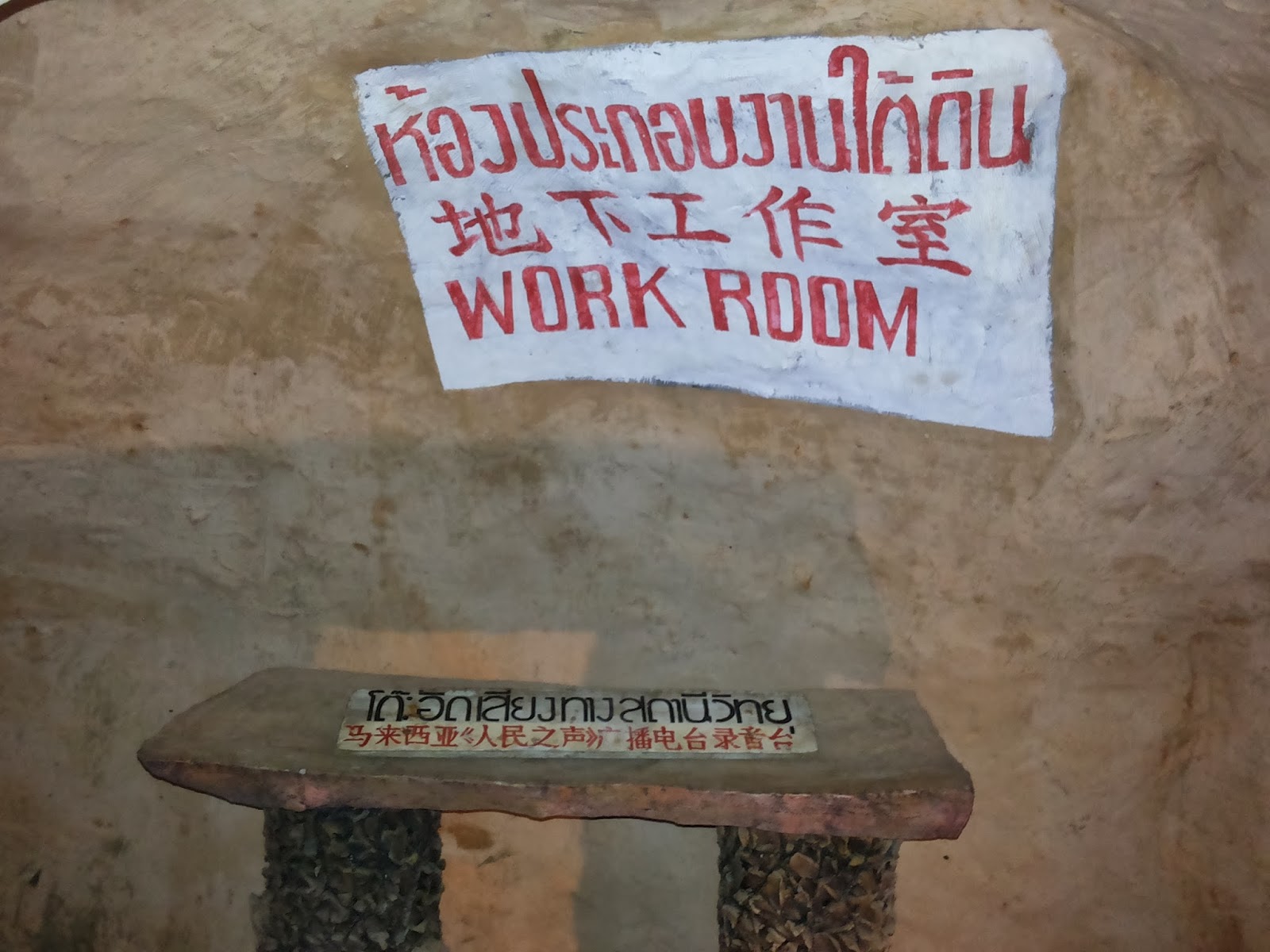
                                          (This was the radio transmission cum work room.)
  (1. Stone bed for married couples in the tunnel. 2. Going into the work room. Taken from a blog.)

 (That's where marriages among the insurgents were held. Allowed to marry but not giving birth.)
            (Praying place. Of course, it was not so elaborately decorated in those days.)
(Equipments & weapons used by the insurgents. Old photos of leading insurgents are in here too.)

                     (Dried wild herbs and wild herbal health tonics are for sale in Piyamid.)
                                                    (Big organic papayas sold at Piyamid.)
                           (Part of the landscape and view in Winter Flower Garden Resort.)
                           (The own-grown organic greens are served in meals at the resort.)
                                 (Flowers welcome visitors to the chalets where they stay.)

Day 2:

                                             (Betong Hot Spring - for soothing tired feet.)
                                               (Clubhouse and chalets at the hot spring.)
              (Simple but quite hearty lunch in a Chinese restaurant owned by an ex-insurgent.)

                                                  (The small museum and observatory.)
                                                  (That's how big or small Betong is.)
                       (Hot sweet bird's nest soup with mild herbs - only RM21 each person.)
                                            (Thick shark's fin chowder in claypot - RM50.)
                                       (We had "supreme" siew mai as appetizer for dinner.)
                                                     (The best fishcakes I've ever tasted.)
                                              (Fragrant fried rice - looks plain but good.)
                                          (Chicken in soy sauce is a popular dish in Betong.)
                                     (Braised trotters - the savory gravy lingers in the palate.)
                                                          (Succulent "king of ribs".)
                                                       (Steamed fish in chilli padi source.)

Day 3:

  (No regrets trying the tim sum for breakfast in this popular restaurant. Photo taken from a blog.)
(Freshly prepared tim sum in varieties but not fully cooked yet. The selected ones will be placed in baskets to be steamed first for serving to customers. Photo taken from a blog.)


(Checked out of Mandarin Hotel at lunch hour and headed for home - no photos.)


Powered by Blogger.